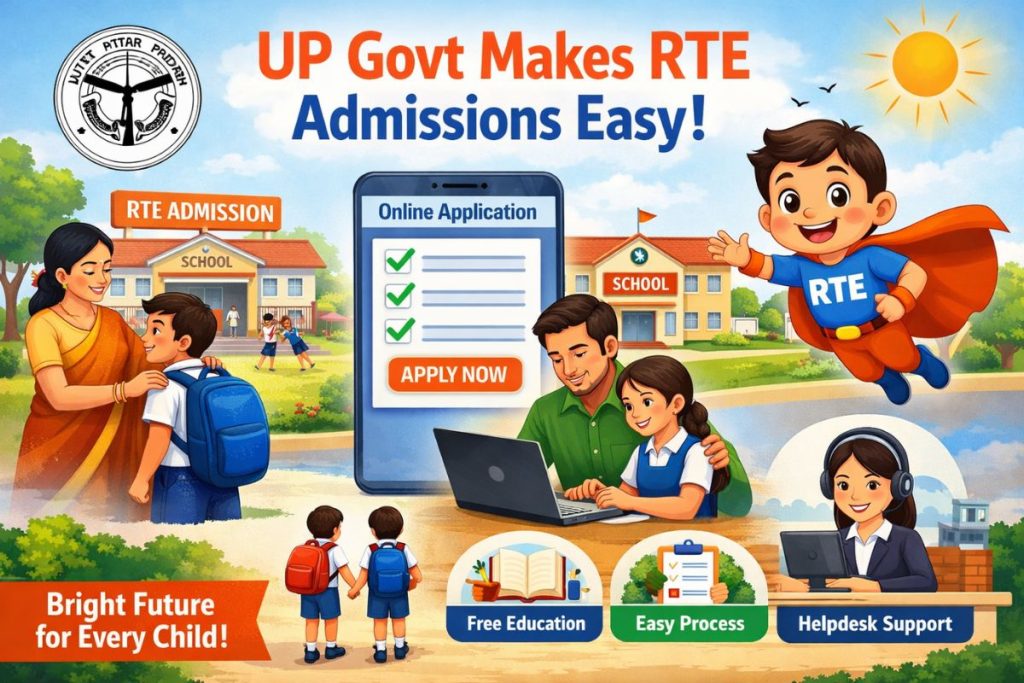
Education is the foundation of a more progressive society and ensuring that everyone has access to high-quality education is an essential goal of government officials across India. In a major policy shift that government officials from the Uttar Pradesh (UP) government has simplified the Right to Education (RTE) admissions procedure for economically weaker and marginalized children who want to enter private schools as per the requirements in the RTE Act, 2009.
The most talked about modification is the elimination the obligatory Aadhaar identification card for children in the online application process. The parents now need only just one of their parents’ Aadhaar to submit the application. This is a significant change that aims to reduce the barriers to accessing education that is free and compulsory across the state.
UP govt makes RTE admissions easy
The Right to Education (RTE) Act 2009 requires that private schools set aside 25 percent in their classrooms at beginning stage (pre-nursery nursery, pre-nursery as well as Class I) for children of economically weaker groups (EWS) and other groups that are disadvantaged. The seats are provided at no cost, which allows children from disadvantaged backgrounds to access a quality education otherwise not accessible.
For Uttar Pradesh, the RTE admissions process is annually conducted on an official RTE portal, which allows parents to apply for admission for their children within the stipulated timeframes. The goal is to guarantee an open and fair allocation of seats, usually by using a lottery system that takes into account factors such as age and preference.
UP RTE Admission Update Details
| Key Point | Details |
| Policy Update | Uttar Pradesh government has simplified the RTE admissions procedure for private schools. |
| Aadhaar Requirement | The child’s Aadhaar Card is not required to be used for admission into RTE. |
| Parent Aadhaar | Aadhaar of any parent is required to complete an online application |
| Beneficiaries | Children of Economically Weaker sections (EWS) and other groups with disadvantages |
| Admission Quota | 25% of seats are reserved for private schools in the RTE Act |
| Classes Covered | Pre-Nursery, Nursery, LKG, UKG, and Class 1 |
| Application Mode | Full online application available through the RTE’s official RTE portal |
| Seat Allocation Method | Online lottery system that is transparent and transparent |
| Verification Process | Online verification is followed by district and block-level checks |
| Financial Support | Government offers assistance with textbooks, uniforms, and other education costs. |
| Objective | Reduce the burden of documentation and ensure an inclusive education |
| Impact | Speedier, simpler and more easily RTE admittances to families |
| Official Website | https://rte25.upsdc.gov.in/ |
UP RTE Admission Major Change: Child’s Aadhaar Not Mandatory
What Changed?
In the past it was the RTE admissions process required Aadhaar information to be provided by both child as well as parents. This led to a number of issues:
- Many children didn’t have Aadhaar cards at the time.
- Parents had to deal with delays or issues with verification because of Aadhaar processing delays.
- Families were required to hold off on the application to avoid not being able to attend the admissions window.
To address these concerns in order to alleviate these issues, UP government has decided to remove the requirement to present the child’s Aadhaar card to be used during the application procedure. Instead, parents are able to complete the application only with one parent’s Aadhaar number.
This changes substantially eases the initial paperwork burden for families, particularly people from marginalized communities as` well as expedites the process of applying.
Why This Matters
- Less Documentation Barriers There are fewer barriers to documenting children: Not all possess Aadhaar yet. The removal of the requirement for a child’s Aadhaar requirement will prevent those who are eligible from being disqualified because of delays in paperwork.
- Greater Inclusion: Poorer families typically struggle with purchasing documents. This reform reduces the hurdle to entry.
- Improvements in accessibility to online services: Parents can be more comfortable completing all of their application online, without having to obtain additional verification documents from the beginning.
How Admissions Work Under the New Policy
Application and Verification
Parents can now apply online with the parent’s Aadhaar number, which is available on the RTE portal. RTE portal. The application comprises:
- Parent’s Aadhaar details
- The basic information of a child (name the child’s name, birth date and gender)
- Age eligibility confirmation
- Local school preferences
After submission, the application goes through online verification and is followed by verification at school block and district levels.
Online Lottery and Seat Allocation
For fairness, and to prevent discrimination:
- Admissions are awarded via a clear two-stage online lottery.
- Parents may choose to select several preferred schools.
- The system assigns seats randomly according to lottery numbers and personal preferences.
- The final list is then approved and released by the education authorities.
Age Eligibility Criteria
The policy clearly outlines the criteria for admissions based on age:
| Class/Level | Required Age |
| Pre-Nursery | 3-4 years old |
| Nursery | 4 to 5 years old |
| LKG | Between 4-5 years |
| UKG | 5-6 years old |
| Class 1 | 7 to 7 years |
Parents should ensure that their child is of the age requirements within the cutoff timeframe specified in the notices.
Benefits and Financial Support Under RTE
The RTE policy doesn’t just offer seats at no cost but also offers financial assistance to assist with the essentials of education:
- Books, uniforms and school equipment: A fixed quantum of financial aid is offered and directly deposited to the parent’s bank Aadhaar linked account.
- School fees are reimbursed: private schools get reimbursement from the state government, at pre-determined rates for students who are leaving -helping to sustain the RTE allocation, without putting schools under pressure.
This helps ensure that economic limitations don’t impede the educational experience of a child.
Ensuring Transparency and Monitoring
To avoid a rash of mistakes The government has stressed an extremely strict surveillance:
- Document Verification: District and block education officers review the authenticity of applications and other documents.
- Lottery Transparency The entire process of allocation of seats is non-discriminatory and open to all.
- Monitoring Mechanisms: The district magistrates as well as education authorities supervise the implementation of the guidelines and make sure that schools are in compliance in accordance with RTE guidelines.
Any violation, such as requesting costs from RTE applicants or denying admission without reason could trigger departmental intervention.
How This Reform Helps Parents and Students
For Parents
- A simplified form of documentation: only the parental Aadhaar will be required.
- A faster application process: online processing cuts down on time and bureaucracy.
- Access to Education: It is easier for families to be involved.
- A clear age criteria: It helps prevent confusion and erroneous information.
For Students
- Improved access for Quality education: More pupils are able to get seats in private schools as part of the RTE allocation.
- Financial Support: Helps to cover the costs for uniforms, textbooks and other necessities.
- Fair Chance Lottery assures unbiased distribution.
Possible Challenges and Considerations
Although the new policy does send positive signals, a few problems remain.
- Aadhaar verification delays: parents should make sure that their Aadhaar is in use and connected to an account at a bank.
- Internet Access: Online applications require reliable internet, which can be difficult in remote areas.
- Learning Rules and Understanding: Parents should be careful to adhere to the age requirements and deadlines.
Despite these difficulties, the new policy reduces the hurdles in comparison to prior guidelines.
Comparison: Before vs After the UP RTE Admission New Update
| Aspect | Before | After (New Policy) |
| Aadhaar Requirement | Child’s Aadhaar must be present for RTE application | The child’s Aadhaar is not required; it’s the parent’s Aadhaar is required. |
| Application Process | Sometimes manual document submission | Online application complete with online verification, lottery and |
The Uttar Pradesh government’s recent reform in the RTE admissions process including the removal of the compulsory requirement for children to have an Aadhaar card requirement is a significant step in making education easier to access and less invasive. By streamlining documentation, simplifying online processes, and ensuring an open allocation system, the policy is designed to assist families across the state in getting high-quality education for their children.
For parents, this provides an opportunity to make use of the RTE provisions without stress and with more clarity. For government, this upgrade is a step forward in the direction of an inclusive and effective digital governance.
FAQ’s
1. Do I require my child’s Aadhaar card in order to apply for RTE admission?
Not in accordance with the latest guidelines of the UP RTE regulations, students will only require only the Aadhaar from one of your parents to be able to submit an application. A child’s Aadhaar is not required anymore during the application process.
2. What happens if I don’t own An Aadhaar ID card?
The application requires parents’ Aadhaar to verify identity and also the transfer of financial assistance. If the parent doesn’t have an Aadhaar It is recommended to apply whenever possible via UIDAI channels or by contacting local authorities in education for assistance.
3. What happens to seats in RTE once you have applied?
Seats are allocated by a transparent online lottery system that is according to parental preferences and lottery results. Education officials review applications prior to making the allocation.