
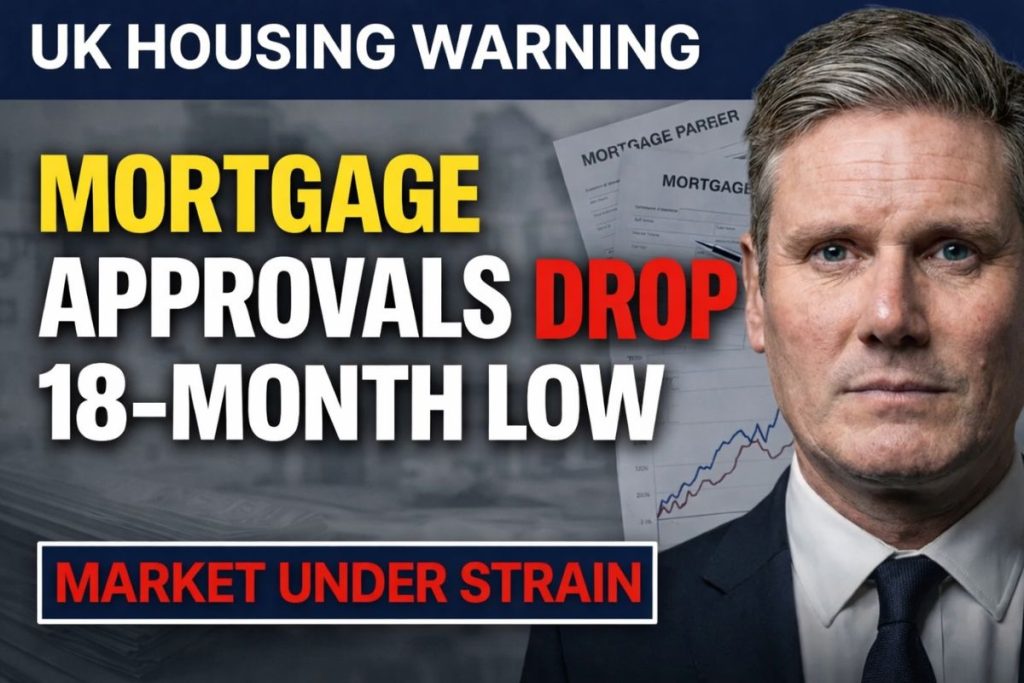
UK home loan approvals dipped to the lowest levels in 18 months and are a sign of renewed tensions on the market for housing as the year 2025 came to an end. New information released by the Bank of England indicates that lending activity declined substantially in December, causing fears that the hope of a robust housing recovery in the early 2026 months could be overly optimistic.
The slowdown is the result of policy adjustments as well as buyer uncertainty and rising costs. Although some wider economic indicators are beginning to improve, mortgage approvals–often seen as a leading indicator of housing transactions–suggest that the property market remains fragile. Analysts are now predicting the recovery to be slow rather than swift.
UK Mortgage Approvals Fall to 18 Month Low
The month of the December of 2025, UK lenders approved mortgages for 61,013 which was the lowest monthly total in the last month since June 2024. The figures fell below economists’ expectations of approximately 64,800 approved mortgages in an Reuters survey. To make matters worse, November’s approval number was revised downwards by 64,530 down to 64,072 which bolsters the notion of a slowdown that continues rather than a dip that was a one-time event.
Mortgage approvals generally preceding actual home purchases by a couple of weeks. Therefore, December’s data suggest home sales in the first quarter of 2026 are likely to be slow even if the buyers’ interest starts to pick up.
UK Mortgage Approvals Fall to 18 Month Low Overview
| Indicator | Recent Data |
| Mortgage Approvals | 61,013 |
| The lowest since | June 2024 |
| Market Forecast | 64,800 |
| The previous month (Revised) | 64,072 |
| Stamp Duty Incentive | The end of the story |
| House Price Steady | Below the level of inflation |
| The outlook for early 2026 | A little weak, but slowly recovering |
| Official Website | https://www.gov.uk/ |
Effect of Stamp Duty Changes and Budget Uncertainty
One of the major factors that contributed to the drop was the expiration of an indefinite stamp duty tax cut which previously enticed buyers to make purchases up to date. When the incentive ran out and demand began to ease, it was almost immediate.
Uncertainty about an uncertain November 2025 budget also played a significant factor. Fears of tax hikes on properties that are worth more caused buyers and sellers to put off. While there was no doubt that final Budget announcements were not as severe than anticipated but the harm to the market was already done particularly during the last period of this year.
Housing Market Sentiment: Cautious but Improving
Market sentiment was generally quiet in the time in between Budget as well as Christmas. Simon Gammon, managing partner of Knight Frank Finance, noted that the pace of housing construction has been “tepid,” with confidence declining even as the fiscal worries decreased.
However there were first indications positive signs. In the Royal Institution of Chartered Surveyors (RICS) reported that sales expectations increased in December and surpassed their highest levels since October 2024. The data suggests that even though sales are still weak, the mood may be stabilizing as the market enters 2026.
House Prices: Rising, but Falling in Real Terms
Despite the decline in approvals for houses, prices have not sunk. They are increasing modestly, but still below inflation which means that prices remain stagnant in real in terms.
Annual Comparative House Price Growth
| Lender | Annual Growth | When compared to Inflation |
| Halifax | 0.3% | Below the level of inflation |
| Nationwide | 0.6% | Below the level of inflation |
With inflation in the consumer market running higher than the growth in house prices homeowners are seeing very little appreciation in real terms that could lower speculative spending and lessen the desire of sellers.
What the Data Signals for Early 2026
Mortgage approvals are often viewed as a signpost to the future. The decline in December indicates that the possibility of a significant increase in the number of mortgage transactions is unlikely to occur within the very first quarter 2026..
Anecdotal evidence from lenders suggests that buyer interest increased in January. If:
- Inflation is continuing to decrease
- Rates of interest remain steady
- Consumer confidence rises
The housing market will then see improvement gradually by the spring of 2026 and not a sudden increase.
Borrowing and Consumer Credit Trends
While mortgage approvals declined, consumer borrowing told an interesting tale.
- Consumer borrowing increased 8.2 percent year-over-year in December, the fastest rate since May 2024.
- The net consumer credit rose in PS1.542 billion which is lower than October’s PS2.143 billion and below expectations.
This indicates that households are borrowing with caution, perhaps prioritizing short-term purchases over long-term commitments, such as home purchases.
Retail Sales Offer a Brighter Signal
Retail sales data showed an optimistic outlook. The December sales grew 2.5 percent over the previous year this was the largest rise from April 2025. The increase in spending by consumers has been a reason for some economists to predict an larger economic recovery the early 2026 regardless of whether the housing market is slow.
In previous cycles housing activity has typically rebounded following increases in confidence and spending which suggests a slow but possibly a turnaround later in the year.
What Buyers and Sellers Should Expect
For purchasers:
- There is less competition than in previous years.
- Greater negotiating power
- Remaining challenges to affordability
For sellers:
- Longer selling times
- The need for a realistic price is vital.
- Demand could increase gradually and not in a sudden way.
The market is stable, but prudent and there is no either a boom or a crash on the horizon.
The most recent Bank of England mortgage approvals depicts an UK housing market that is still struggling. With approvals at a low of 18 months and the forecast for 2026’s early period is not likely to see a rapid increase in the number of transactions. However, rising attitudes, lower inflation and increased retail spending suggest that the foundations for a recovery could be beginning to form.
In contrast to a swift recovery, the housing market appears to be heading for an slow and cautious recovery as buyers as well as sellers and lenders all waiting for more clear economic indicators. The next months of data on approvals will determine the extent to which confidence has returned, or if the slowdown continues to grow.
FAQ’s
1. Why are UK mortgage approvals falling?
The drop is a result of the end of incentives for stamp duty in the UK, pressures to be affordable, and the uncertainty that will come with the 2025 Budget.
2. Does falling approvals mean house prices will crash?
Not necessarily. Prices are growing slowly, however they are below inflation which suggests stagnation and not the possibility of a dramatic drop.
3. When could the housing market recover?
Analysts predict that any recovery will be gradual, but could gain momentum before the end of 2026 or in the middle of spring when the economic situation improves.