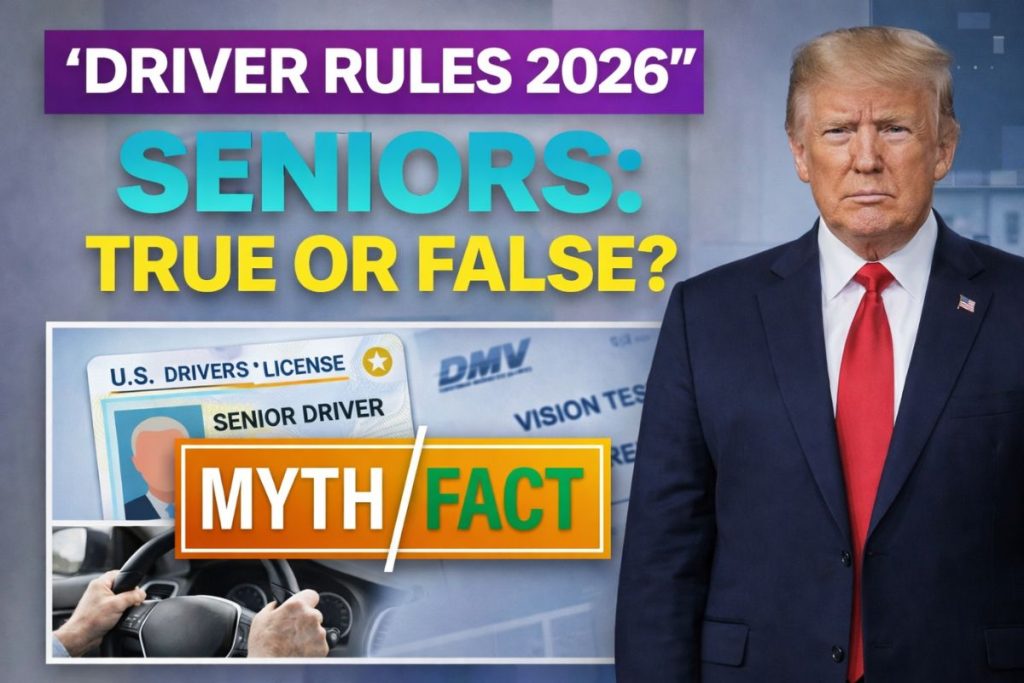
As January 2026 begins, millions of older Americans and their families are searching for clear answers about driver’s license rules for seniors. Across social media platforms, YouTube videos, messaging apps, and even some poorly sourced websites, alarming claims have circulated suggesting that drivers aged 70 or older now face mandatory annual road tests, compulsory vision exams, heavy fines, or even jail time if they fail to comply.
These claims have understandably caused anxiety—especially among seniors who depend on driving for independence, medical appointments, shopping, and staying socially connected. However, most of these viral headlines are misleading or completely false. There is no new federal law in 2026 that imposes nationwide testing, penalties, or license cancellations based solely on age. Driver’s license regulations in the United States remain firmly under state authority, and policies continue to vary widely from one state to another.
Who Controls Senior Driver’s License Rules?
One of the most important facts often overlooked in online discussions is that the federal government does not issue driver’s licenses.
Instead:
- Each state controls licensing rules
- Each state decides renewal periods, testing requirements, and restrictions
- States may revise rules independently, without affecting others
This means there is no such thing as a nationwide senior driving law unless Congress explicitly passes legislation—and no such law exists in 2026.
When people see headlines claiming “All seniors must retest in 2026,” they are almost always confusing state-level updates with federal mandates.
New 2026 Senior Driver’s License Rules Overview
| Key Detail | Information |
| Authority Over Licenses | State Departments of Motor Vehicles (DMVs) |
| Nationwide Senior Law | No federal age-based law |
| Mandatory Annual Road Tests | Not nationwide |
| Vision Exams | State-specific, not federal |
| License Cancellation | Only after safety or medical review |
| REAL ID Requirement | Applies to all drivers, not seniors |
| States With Senior-Specific Policies | CA, TX, FL, IL, NY (examples) |
| Best Information Source | Official state DMV websites |
| Official Website | https://www.dmv.ca.gov/ |
Why Are Senior Driving Rumors Spreading So Quickly?
The spread of misinformation about senior drivers can be traced to several real-world trends:
1. America’s Aging Population
People are living longer and healthier lives. Many Americans continue driving well into their 70s, 80s, and even 90s. This has naturally increased discussions about road safety and aging.
2. State-Level Policy Updates
When a state like Illinois or Florida updates renewal procedures, some online sources exaggerate the change and frame it as a nationwide rule.
3. Clickbait and Fear-Based Headlines
Phrases like:
- “Goodbye to senior drivers”
- “Jail time for elderly motorists”
- “Annual tests now mandatory”
are designed to generate clicks—not provide accurate information.
4. Confusion Around REAL ID
The REAL ID Act became fully enforceable in 2025, and many people mistakenly believe it introduced senior-specific requirements. It did not.
REAL ID: What It Is—and What It Is Not
The REAL ID Act requires compliant identification for:
- Boarding domestic flights
- Entering federal buildings
It applies to:
- All drivers
- All age groups
REAL ID does not:
- Target seniors
- Require road tests
- Change renewal age limits
- Cancel licenses
If your license is REAL ID–compliant, you meet federal ID requirements—nothing more.
Do States Revoke Licenses Based on Age Alone?
Not a single U.S. state revokes a driver’s license solely because a person reaches a certain age.
What states may do instead:
- Shorten renewal periods
- Require in-person renewal
- Request vision screening
- Order medical evaluations if safety concerns exist
These measures are designed to ensure road safety, not to punish older drivers.
Examples of State Rules in 2026
Below are commonly cited states—often misunderstood in viral posts.
Illinois
Effective July 1, 2026:
- Drivers 87 and older must take a road test
- Drivers 79–86 must renew in person and pass a vision test
- No automatic license loss
- No penalties or fines
California
- Drivers 70+ must renew in person every five years
- Vision test required
- Road tests only if driving ability is questioned
Texas
- Senior drivers renew in person
- Vision exam required
- Shorter license validity periods
Florida
- Drivers 80+ must pass a vision test at renewal
- Renewal every six years
New York
- No age-based testing
- Vision certification required for all drivers, regardless of age
Each state operates independently, and none impose nationwide mandates.
When Can a Senior Be Required to Take a Road Test?
Road tests are typically required only when:
- Multiple accidents occur
- Serious traffic violations are recorded
- A medical condition affecting driving is reported
- A doctor, law enforcement officer, or family member submits a concern
Even then:
- The process includes notice and review
- Drivers can appeal
- Restrictions may be issued instead of revocation
Medical Conditions and Driving Safety
States may evaluate driving ability if a person is diagnosed with:
- Advanced vision impairment
- Severe cognitive decline
- Neurological disorders
- Conditions affecting reaction time
Importantly:
- Diagnosis ≠ automatic license loss
- Evaluations are individualized
- Many drivers continue driving with restrictions
Role of Families and Caregivers
Family members often worry about an older loved one’s safety. Most states allow concerned individuals to:
- Submit a confidential request for DMV review
- Trigger a medical or skills evaluation
- Avoid confrontation while protecting safety
This system exists to balance independence with responsibility.
Practical Tips for Senior Drivers in 2026
Stay Informed
- Visit your state DMV website
- Ignore viral posts and unverified sources
Monitor Health
- Schedule regular eye exams
- Discuss driving ability with doctors
Consider Defensive Driving Courses
- Improve skills
- Reduce insurance premiums
- Build confidence
Prepare for Renewals
- Renew early
- Bring required documents
- Ask DMV staff questions
What Has NOT Changed in 2026
Let’s be absolutely clear:
- No federal senior driving law
- No mandatory annual road tests nationwide
- No age-based jail penalties
- No automatic license cancellations
- No fines for simply being older
The Reality Behind the Headlines
The truth is less dramatic—but far more reassuring.
The government is not targeting seniors. Instead, states are:
- Responding to changing demographics
- Focusing on safety-based evaluations
- Preserving independence wherever possible
Driving policies in 2026 remain rooted in ability, health, and safety, not age discrimination.
As of 2026, there are no nationwide changes forcing senior drivers to undergo annual testing, vision exams, or penalties. The only federal requirement affecting licenses—the REAL ID Act—applies equally to all Americans.
Senior driving rules continue to be set by individual states, and most updates are modest, reasonable, and safety-focused. Misinformation thrives online, but facts remain clear when checked against official sources.
If you or a loved one have concerns, always rely on:
- Your state DMV website
- Licensed medical professionals
- Official government notices
Staying informed is the best way to protect both independence and peace of mind.
FAQ’s
Q1. Is there a new federal law in 2026 requiring seniors to take annual driving tests?
There is no federal law in 2026 that requires seniors to take annual road tests or vision exams. Driver’s license rules are controlled by individual states, and any testing requirements vary by state and personal driving or medical history.
Q2. Can a driver’s license be canceled automatically just because someone turns 70 or older?
No state cancels a license solely based on age. Licenses may only be reviewed or restricted if there are safety concerns such as medical issues, multiple accidents, or serious traffic violations.
Q3. How can seniors check the exact driving rules that apply to them?
The most reliable way is to visit the official website of your state’s DMV or contact them directly. Seniors should avoid relying on social media posts or viral headlines, which often contain misinformation.