In recent weeks, reports or social media updates proclaiming that Americans have to be ready to say “goodbye in retirement at 67” have caused worry and confusion among both workers as well as retirees. There are reports that suggest that it is possible that Social Security retirement age is increasing again in 2026, which will force workers to work for longer to collect the full benefit. But, these assertions are incorrect.
The law in place is no law that will alter this Social Security retirement age. In fact, 2026 is an important point in the transition that began over four decades years ago. This is the year that you will reach the full retirement Age (FRA) that is 67 will be fully applied to all born after 1960 in accordance with the rules established in earlier legislation. Knowing what this means and what it doesn’t mean is vital for planning retirement.
Goodbye to Retirement at 67
A Full Retirement Age is the minimum age at which a person can get the full amount of their estimated Social Security retirement benefit. This is however not mean that you have to quit working or retire, nor does it mean that you cannot claim benefits earlier or later.
FRA serves as a reference point that is used to calculate The Social Security Administration to calculate reductions in early claims and increases for delayed claims. By 2026, FRA will remain in effect for 67 years for those born after 1960, exactly as it is defined in the current law.
Goodbye to Retirement at 67 Overview
| Category | Details |
| Authority | Social Security Administration (SSA) |
| Program Name | Social Security Retirement Benefits |
| Program Type | Federal Social Insurance |
| Country | United States |
| Full Retirement Age (2026) | 67 years old |
| Earliest Claiming Age | Age 62 |
| Delayed Retirement Credits | Up to age 70 |
| Minimum Work Credits | 40 Credits (10 year of experience) |
| Official Website | ssa.gov |
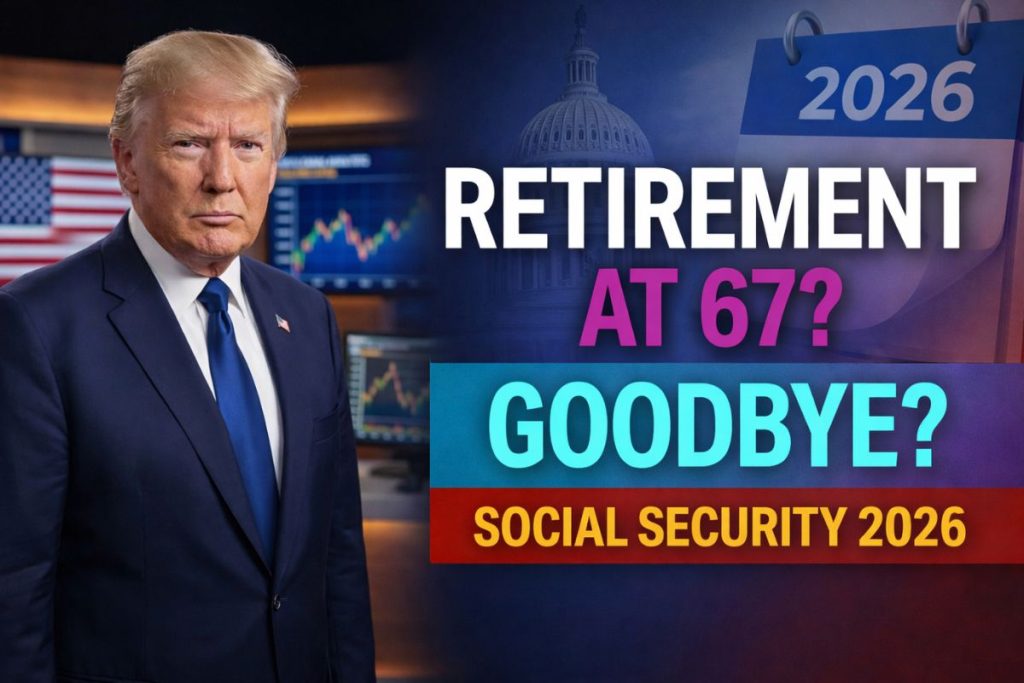
Why 2026 Is Getting So Much Attention
The reason 2026 has attracted attention is not due to the new rule rather, it is because the final phase of a lengthy gradual rise is completed.
The Social Security Amendments of 1983 increased the full retirement age gradually, in order to take into account a longer lifespan and to ensure the sustainability of the program. This increase started with people born in 1938, and then was completed with those born in 1960 or after.
By 2026:
- Anyone who reaches retirement age is covered by the age of 67 to be considered a FRA
- There are no groups that have an FRA lower than 67.
- The transition period officially done
This has created confusion, as some people mistakenly interpret the milestone as an rise.
Full Retirement Age by Birth Year
| Year of Birth | Full Retirement Age |
| 1943-1954 | 66 years old |
| 1955 | 2 months, 66 years old |
| 1956 | 4 months, 66 years. |
| 1957 | 66 years 6 months |
| 1958 | 8 months, 66 years |
| 1959 | 10 months, 66 years |
| 1960 or later | 67 years old |
The schedule is fully completed and there are no more increases currently in effect.
Claiming Social Security: Your Options Still Exist
Even though they have the FRA at 67 people can still choose the way they use their benefits.
Early Claiming (Age 62)
- Open to all workers who are eligible
- The monthly benefits are always cut
- Reduction ranges from 25%-30 to a dependent on the year of birth.
- Ideal to those who need money earlier or are suffering from health issues.
Full Retirement (Age 67)
- Get 100 percent of your benefit
- No penalty for earnings after FRA is attained.
- Work on the same schedule without reductions
Delayed Claiming (Up to Age 70)
- Benefits rise by around 8 percent each year following FRA
- The maximum benefit is attained at the age of 70
- Particularly beneficial for those who have a longer life expectancies or better earnings experiences
Does FRA Mean You Must Work Until 67?
No. Social Security does not need any person to work beyond an age.
You can:
- Retire earlier and defer benefits
- Retire later and receive benefits earlier
- Continue to work while receiving benefits (with some limitations before FRA)
Retirement decisions are a personal matter and can be flexible. FRA is only a factor in the amount you get, not the extent to which you will be eligible to receive benefits.
Could the Retirement Age Increase Beyond 67 in the Future?
Although it is no law in the present that would increase FRA beyond the age of 67, lawmakers have considered options as part of longer-term Social Security solvency debates.
A few suggestions suggest:
- Gradually increasing FRA to either 68 or 69.
- Making changes only for the younger workforce
- Exempting current retirees as well as near-retired
Potential Impact If FRA Were Raised to 69
- Future workers will have to wait longer in order to receive full benefits
- The penalties for early claims would be more severe
- Lifetime benefits may decrease around 10-13%.
- Workers who are physically demanding are likely to be the most affected.
However, discussion does not equal law. Any changes would require:
- The approval of Congress
- Signature of the President
- The years of gradual implementation
What Has Not Changed in 2026
In spite of internet rumors, these are the same:
- The early retirement option is not eliminated at the age of 62.
- There will be no further increase after FRA 67.
- There is no obligation to stop working at any time
- No automatic cuts in benefits in 2026 or 2026 alone.
All calculations of benefits continue as per the current statutes.
How to Check Your Personal Social Security Outlook
To obtain accurate, customized information to get accurate, personalized information, the SSA suggests:
- Creating a my Social Security account at ssa.gov
- Re-examining your earnings record for the entirety of your life
- Utilizing benefit calculators to assess age ranges for claiming benefits
- Be aware of estimates when your income fluctuates
These tools are based on the law of the moment They do not reflect the latest political or legal theories.
The expression “goodbye in retirement age” could seem alarming, however it’s not the reality. There is any recent Social Security law passed in 2026 which would increase the retirement age to 67. The age is the last full retirement age set in the past by those reforms of 1983.
Americans are left with a choice to take advantage of early retirement, or delay until they reach full retirement age, or wait to receive more benefits. Future changes will require legislative clarity and a long period of notice.
At present, Social Security retirement rules remain in place and planning on the official SSA information is the most effective method.
FAQ’s
Q1. Does it possible to see the Social Security retiree’s age rising in 2026?
No. Social Security retirement age is not set to increase in 2026. Full retirement (FRA) is at 67 years for those born after 1960. This law was created under legislation passed earlier that was not a change that is new. Any further increase will require the approval of Congress or the President.
Q2. Can I still claim Social Security benefits at age 62 in 2026?
Yes. Workers who are eligible can still be eligible to claim Social Security retirement benefits as late as the age of 60 by 2026. But, making claims before the reaching full retirement age will result in the possibility of a permanent decrease of monthly Social Security benefits. Typically, this is at least 30% less than the total benefit amount.
Q3. What happens if I delay Social Security beyond age 67?
If you wait to claim Social Security beyond age 67 the monthly benefit will increase by around 8 percent each year until you reach the age of 70. This could significantly increase benefits over the course of your lifetime, particularly for people with a longer life expectancy or larger incomes over the course of their lives.