
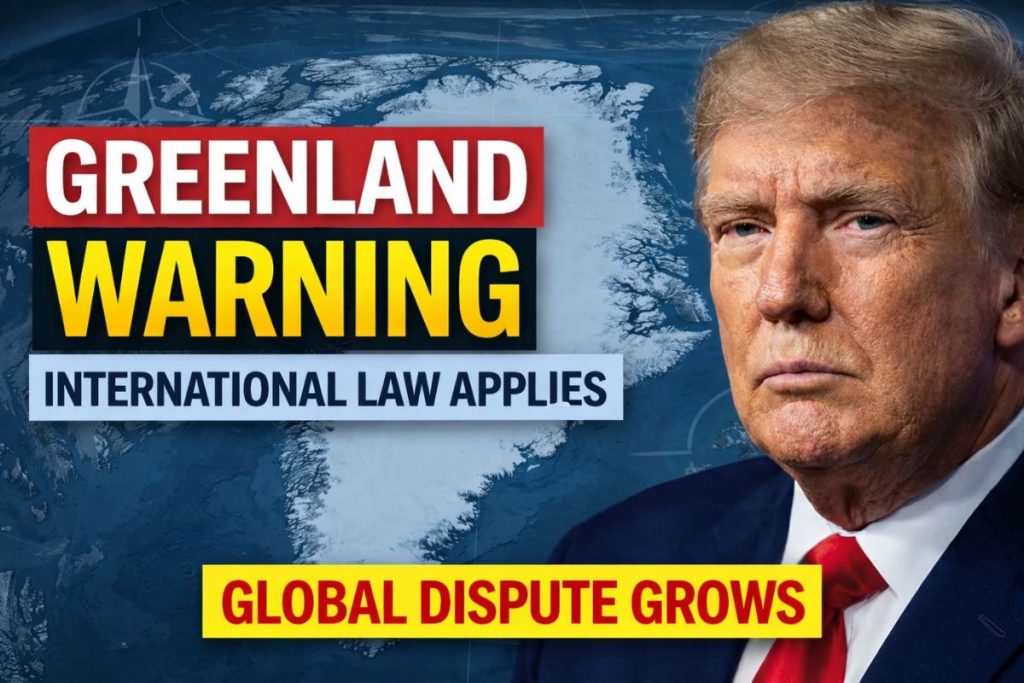
Greenland is an enormous Arctic region that is more famous due to its vast ice sheet and Indigenous history than its the global politics of power, has recently been portrayed as a point for international conflict. Recurrent comments from the former U.S. President Donald Trump concerning possible U.S. control over Greenland has rekindled debates over the sovereignty of Greenland, its international laws as well as the long-term future for the Arctic. Although such remarks could be controversial or even symbolic however they also reflect larger geopolitical considerations that relate to security, resources and climate changes.
Responding to these developments the finance minister of Germany Lars Klingbeil issued an unambiguous note of caution that international law is applicable to all, even that of the United States. This statement was a clear reminder of a key concept of modern diplomacy: that territorial integrity and self-determination can’t be influenced by pressure from political or the military. Klingbeil stressed that the future of Greenland is a matter for Denmark as well as Greenland itself and not by external actors.
Why Greenland Matters More Than Ever
Greenland’s increasing geopolitical importance is due to three interconnected aspects: resources, location and climate changes. Once thought to be isolated and remote The island is now seen as an important strategic asset in an ever-changing world.
Strategic Location in the Arctic
Greenland is located in between North America and Europe, which makes it an ideal site for military surveillance missile defense, as well as early warning systems. As Arctic glaciers melt new sea routes are being opened which could speed up the time for shipping across Asia, Europe, and North America. This change has turned into the Arctic into a place that is of renewed strategic importance to the world’s major powerhouses.
A New Era of Arctic Competition
Countries, including countries like the United States, China, Russia as well as countries that are part of the European Union are increasing their Arctic presence. Research stations, military exercises and diplomacy initiatives have been expanding to the north. Greenland because of its size and position is a key element in these goals, yet its political and legal status is still firmly within international norms.
German Finance Minister Warns U.S. Overview
| Topic | Key Details |
| Main Issue | International law and sovereignty in Greenland |
| Key Statement | Germany is warning that the law of international trade is applicable to everyone |
| Central Figures | Lars Klingbeil, Donald Trump |
| Greenland’s Status | Territories that are autonomous within Denmark |
| Strategic Importance | Rare earth mineral, Arctic security, shipping routes |
| Environmental Factor | Rapid melting of ice and climate change |
| Legal Framework | International law and self-determination |
| Alliance Impact | The possibility of tension on NATO unity |
| Future Outlook | Conflict versus cooperation in the Arctic |
| Official Website | https://www.usa.gov/ |
Rare Earth Minerals: The Economic Driver
One of the main reasons that drive the global fascination with Greenland lies in its mineral richness in rare earths. These minerals are crucial for advanced technologies, such as:
- Batteries for electric vehicles
- Solar panels and wind turbines
- Electronics and smartphones
- Systems for military and aerospace
As the world continues to accelerate its transition to cleaner energy sources, mining demand is growing dramatically. Global supply chains are largely concentrated in certain countries, leading to weaknesses. Greenland is frequently viewed as a possible alternative that could help diversify supply.
But mining rare earths isn’t straightforward nor is it risk-free. The minerals are extremely complex chemically and are often paired with radioactive substances. Mining them requires huge-scale industrial processes, that can could pose significant environmental risks, particularly in the vulnerable Arctic ecosystem.
Environmental Costs and Climate Reality
Greenland is currently in the forefront in the process of climate alteration. Scientists believe that the Greenland Ice Sheet is responsible for approximately 20-25 percent of sea-level rise in the world. If the warming trend continues, Greenland alone could raise the global sea level by several inches by end of the century.
Global Consequences
The impacts aren’t limited only to Arctic. Seas rising could pose a threat to:
- Cities that are coastal in Europe, the United States and Europe
- Low-lying island countries
- Critical infrastructure across the globe
Local Ecosystems Under Threat
Greenland’s wildlife, which includes polar bears Arctic Foxes, musk oxen as well as whales and reindeer – all depend on the stability of tundra and ice conditions. As temperatures increase the habitats are shifting more quickly than animals can adapt. The indigenous communities, who’s lives depend on traditional fishing and hunting are also confronting unprecedented difficulties.
These realities raise fundamental issues How can large-scale mining be co-exist in a sustainable environment? Who is responsible in the event of irreparable harm?
International Law and Greenland’s Legal Status
Greenland can be described as an autonomous state within the Kingdom of Denmark, with its own parliament as well as significant self-governing power. While Denmark manages defense and foreign matters, Greenland retains the right to determine its own self-determination in accordance with international law.
This legal framework encapsulates:
- Greenland is not available for purchase without the consent of the owner.
- Any changes in status have to require the involvement of Greenlandic as well as Danish authorities.
- International law rules over the political rhetoric
Klingbeil’s warning is a reflection of the larger European worries that allowing unilateral acts could compromise the rules-based international system. If powerful nations violate the law smaller states and territories may be under greater pressure globally.
NATO and Alliance Stability
Germany’s involvement is also linked to the alliance’s politics. Both Germany as well as Denmark belong to NATO and a united front within NATO is thought to be crucial, particularly in light of ongoing security threats to the world.
Any unilateral move that involves Greenland could lead to:
- Cause diplomatic friction within NATO
- Undermine trust among allies
- Set a precedent to ignore sovereignty
In a time where collaboration is crucial to address security risks as well as climate change as well as economic uncertainty, differences could have a wide-ranging impact.
Indigenous Rights and Local Voices
Ofttimes, what is not heard in geopolitical discussions is the voice of Greenland’s Indigenous people. Mining, infrastructure as well as international collaborations directly impact the local communities.
Important concerns include:
- Water and land protection
- Preservation of traditional practices
- Long-term economic stability
Many Greenlandic leaders insist that development should be guided by local consensus and should benefit residents rather than external forces looking for short-term gain.
The Future of Arctic Governance
Greenland’s circumstances highlight a bigger global problem that is how to regulate areas that are experiencing rapid economic and environmental transformation. Analysts are increasingly calling the need for “patient statesmanship”, an approach that focuses on
- Multilateral cooperation
- International law must be respected.
- Environmental Stewardship
- Indigenous participation
This approach acknowledges that although resources are important however trust and stability are more important.
The Greenland dispute goes beyond than just a dispute over diplomatic relations. It is an examination of how international cooperation will respond to the effects of climate changes, resource competition and changing power dynamics. Germany’s assertion that international law is applicable to everyone is an example that, even in the midst of a period of strategic competition rules are still important.
Greenland’s future depends on whether countries opt for cooperation or confrontation and be mindful of sovereignty over ambition and the long-term sustainability of their decisions over short-term gain. As the Arctic continues to warm, and world demand for resources rises the decisions taken today will not only determine Greenland’s future, but also the credibility of international law as well.
FAQ’s
1. Why is Greenland attracting so much global attention now?
Because melting ice is giving the doors to rare earth minerals as well as new shipping routes as well as strategic military positions which makes Greenland important both geopolitically and economically.
2. Can any country legally take control of Greenland?
Not at all. Greenland’s sovereignty is protected by international law. Any modification must require Greenlandic or Danish consent.
3. Why did Germany issue a warning to the U.S.?
Germany is worried that not observing international laws on the Arctic could undermine alliances and undermine the rules-based global order.