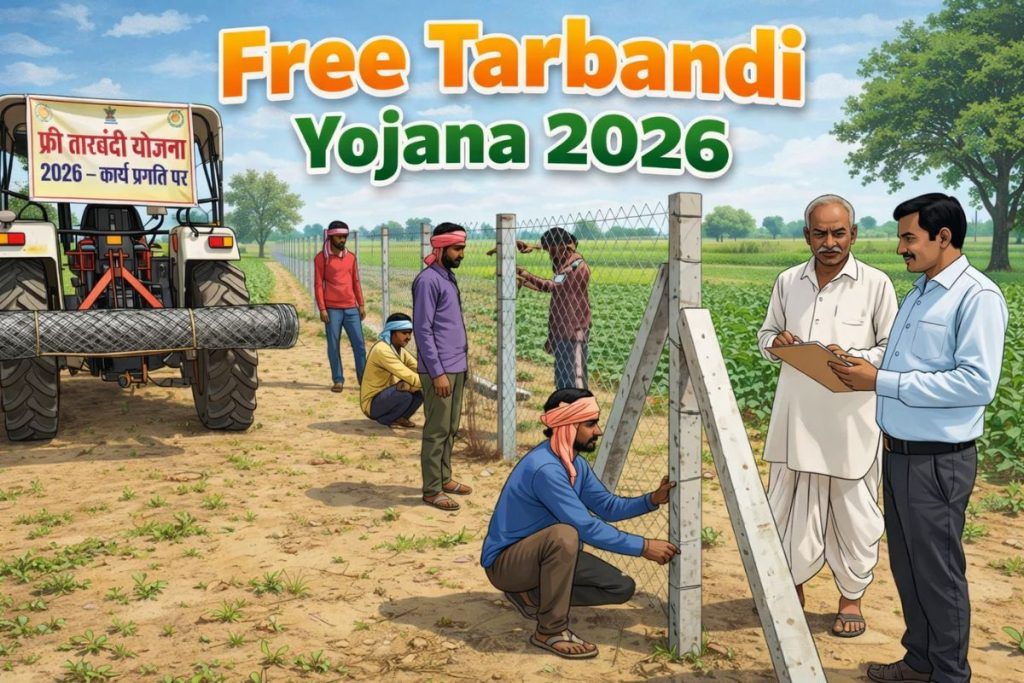
Indian farmers confront a similar issue every season: crop damage caused by roaming livestock, wild animals and sudden cattle grazing. Despite their hard work and the rising input costs, one night of ruin can slash months of hard work. Recognizing this reality and the need for improvement, the government has introduced their Free Tarbandi Yojana 2026, providing much-needed help for marginal and small agriculturalists across India. Through this scheme, farmers who are eligible will receive financial assistance as high as Rs 56,000 to assist in building fences (tarbandi) around their farm property.
The goal of the initiative is to minimize loss of crops, increase efficiency of the farm, and provide stable income. With a simple eligibility requirement as well as a full or partial subsidy and a farmer-friendly application procedure The Free Tarbandi Yojana 2026 is becoming a revolutionary aid system for protecting crops and security of rural livelihoods.
What Is Free Tarbandi Yojana 2026?
The Free Tarbandi Yojana 2026 is a welfare scheme for farmers that is funded by the government that is designed to safeguard farmland through subventions for fencing solutions. “Tarbandi” refers to fencing placed around fields of crops to protect against intrusion by wild animals, stray cattle and unintentional pastures.
Recently, the damage to crops caused by animals like cows, nilgai and nilgai as well as goats, wild boars and others has been increasing significantly, particularly in semi-forest ous and rural regions. A lot of farmers quit cultivation or switch to less risky crops because of fears of loss. This scheme addresses that issue by providing farmers by providing financial assistance to construct durable fencing systems.
The amount of assistance is up to Rs56,000, based on the size of land the fencing type and size, as well as the norms of the state government. Some states provide 100% subsidies for certain categories of farmers.
Free Tarbandi Yojana 2026: Overview Table
| Feature | Details |
| Scheme Name | Free Tarbandi Yojana 2026 |
| Objective | Protection of crops from animals and grass grazing |
| Maximum Assistance | Up to Rs56,000 |
| Beneficiaries | Small and marginal farmers |
| Type of Support | Subsidy / Financial assistance |
| Coverage | Fences around agricultural land |
| Fencing Types | Chain-link, barbed wire, solar fencing |
| Application Mode | Online / Offline (State-wise) |
| Benefit Frequency | Once per eligible landholding |
| Official Website | https://www.govtschemes.in/ |
Why Free Tarbandi Yojana 2026 Is Important for Farmers
1. Rising Crop Damage Losses
Wild animals and stray cattle create thousands of crores of loss every year. Small-scale farmers are the ones most impacted because they have no resources for a protective infrastructure.
2. Cost of Fencing Is High
Fences can cost between Rs40,000 and Rs70,000 per an acre, which is prohibitive for farmers who are marginal. This subsidy eases the burden.
3. Improves Crop Yield and Confidence
With a secure fence farmers can plant valuable crops such as fruits, vegetables, and cash crops with no worries.
4. Supports Sustainable Farming
Fencing eliminates the need for nightguards as well as conflict with animals and other stress-related farm decisions.
Key Benefits of Free Tarbandi Yojana 2026
- Support for financial needs up to Rs 56,000
- Protection from stray cattle as well as wild animals
- The rate of survival of crops has increased
- Promotion of multi-cropping and the horticulture
- Reduction of distress for farmers and migration
- A boost to rural income and food security
Types of Fencing Covered Under the Scheme
Different states permit different fencing options for the Free Tarbandi Yojana 2026:
1. Barbed Wire Fencing
- Most often, they are approved
- Cost-effective
- Ideal for dry and plain regions
2. Chain-Link Fencing
- More durable
- The amount of higher subsidy
- Ideal for orchards and vegetables farms.
3. Solar Fencing (Selected Areas)
- Useful in areas with wildlife
- Eco-friendly
- Eliminates entry by wild animals, without harm
Financial Assistance Details (Subsidy Structure)
The amount of the subsidy is different by state, but the basic scheme is:
- 50 to 70% of the subsidy is for all farmers.
- 75% – 90% subsidies for marginal and small farmers.
- Up to 100% of the subsidy in some states for SC/ST farmers in certain states.
The maximum amount of assistance is 56,000 rupees
In the majority of cases farmers will first construct fencing before receiving reimbursement following confirmation.
Eligibility Criteria for Free Tarbandi Yojana 2026
In order to apply farmers, they must meet the following requirements:
- The applicant should be an Indian citizen.
- Legally lease or own land for agriculture.
- Land records need to be kept up-to-date
- The applicant must be a marginal or small farmer (priority)
- Fencing should be installed on land that is suitable for cultivation
- Farmer shouldn’t have received the same benefit prior to him.
Documents Required for Application
Make sure these documents are available:
- Aadhaar Card
- Documents for land ownership (Khata or Jamabandi or Patta)
- Passbook for banks (linked to Aadhaar)
- Sized for passports
- Mobile number
- Certificate of Caste (if appropriate)
How to Apply for Free Tarbandi Yojana 2026 (Step-by-Step)
Step 1: Visit Official Agriculture Portal
The state of each has an department of agriculture online portal, or an offline system for applications.
Step 2: Fill Application Form
Input personal information including land details and fencing requirements.
Step 3: Upload Documents
Upload scanned copies of the required documents.
Step 4: Submit Application
After submitting, take note of the application number to track.
Step 5: Field Verification
Agriculture officials confirm plans for fencing and land.
Step 6: Install Fencing
After approval, construct fencing in accordance with the guidelines.
Step 7: Receive Subsidy
Subsidy funds are transferred straight to the bank’s account through DBT.
State-Wise Implementation Highlights
- Rajasthan Demand for Rajasthan is high due to stray cattle problems
- Madhya Pradesh: Special focus on small-scale farmers
- Uttar Pradesh: Priority to districts afflicted by animals
- Maharashtra Chain-link fencing is generally endorsed
- Karnataka and Telangana Solar fencing in villages bordering the forest
Impact of Free Tarbandi Yojana on Indian Agriculture
Increased Crop Security
Farmers have reported 70-80% less crop damage following fencing.
Better Crop Choices
Farmers shift their focus to fruit, vegetables, and other high-value crops.
Reduced Human-Animal Conflict
There is less chance of conflict with livestock and wild animals.
Improved Rural Livelihood
The steady income helps farmers keep cultivating.
Challenges & Limitations of the Scheme
- Budgets are tight in certain states.
- The delay in reimbursement for subsidy
- Small farmers aren’t aware of the problem.
- Variation in cost norms for fencing
Despite these difficulties, the system is effective when it is implemented correctly.
Expert Tips for Farmers Applying for Tarbandi Yojana
- Start applying early in the fiscal year
- Check that land records are current
- Only use fencing materials approved by the governing body.
- Make sure you take photos of fence installations
- Be sure to follow the guidelines of the department of agriculture
The Free Tarbandi Yojana 2026 is more than a subsidy, it provides a safety net for farmers who put in a lot of work. By safeguarding the crops, reducing losses and helping to restore confidence this scheme is a crucial part of strengthening India’s backbone in agriculture. Farmers who are planning to protect their crops for the upcoming seasons should not overlook this chance. When applied in a timely manner and with the complete documentation, this plan will improve farm safety as well as productivity and stability.
FAQ’s
1. What amount of will be the subsidy under the Free Tarbandi Yojana 2026?
Farmers may receive financial aid that can be as high as Rs56,000 dependent on the size of their land fence type, land size, and government subsidy guidelines.
2: Is Free Tarbandi Yojana available in all states?
The program is administered in a state-specific manner, with different rules. The majority of major states that have agricultural programs offer this benefit as part of their agricultural departments.
3. Can farmers who are tenants be eligible to this scheme?
Yes, tenants can apply for a permit if they possess legal lease documents and have approval as per the state guidelines.