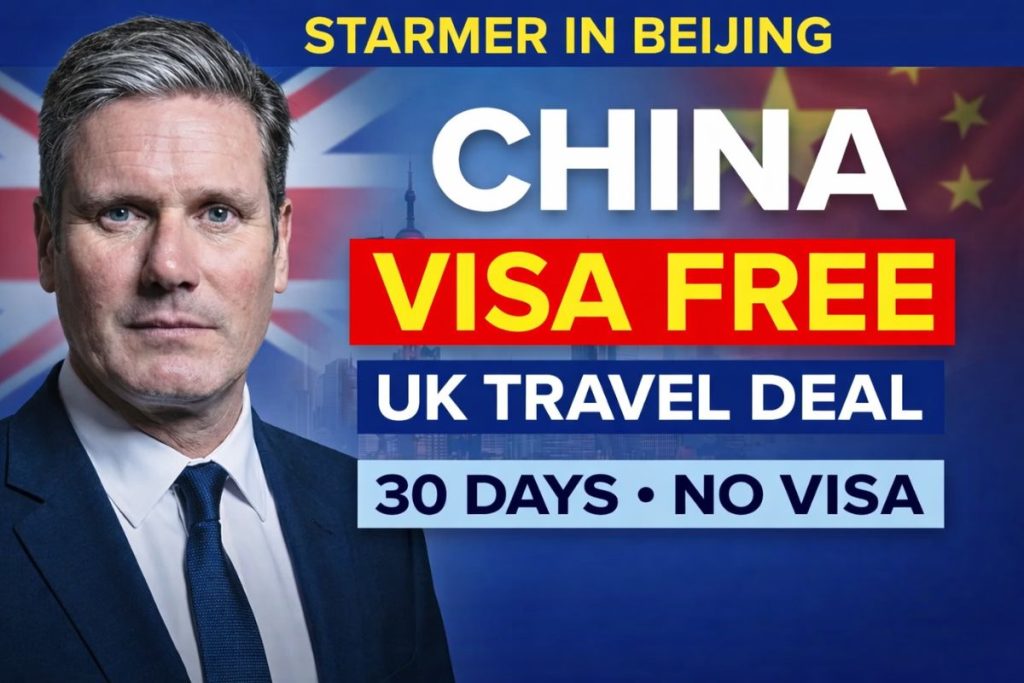
China has announced a major change in visa regulations for UK citizens which will permit visa-free travel to China for stays that last up to 30 consecutive days that marks a major change in the relationship between China and the United Kingdom. The announcement was made in the course of the prime minister’s visit to Beijing. Keir Starmer’s official visit to Beijing after high-level discussions between him and Chinese China’s President Xi Jinping.
The move is widely regarded as a significant revolution in trade and tourism, business travel and service sector cooperation and comes at a moment when both nations are trying to find an economic boost amid the uncertainty of global markets. UK officials have said that the deal will allow professionals, businesses as well as travelers to work in a meaningful way with China as well as protecting national interests.
What the New Visa Policy Means
With the updated regulations, UK passport holders do not have to apply for an entry visa for trips to China with a duration of not more than thirty days. This is applicable to a wide spectrum of travel-related purposes that include business meetings and conferences and cultural exchanges, tourism as well as short-term academic trips.
In the past, British travelers often faced lengthy processing times for visas as well as documentation requirements or scheduling problems. The new policy eliminates the obstacles and makes travel more efficient affordable, more economical, and certain.
UK officials have described the decision as a pragmatic and pro-growth move rather than an admission of political power.
China Eases Visa Rules for UK Citizens Overview
| Key Detail | Information |
| Visa Policy Change | Visa-free travel is available to UK citizens |
| Maximum Stay | All the way to 30 days |
| Announcement Timing | During PM Starmer’s Beijing visit |
| Affected Travelers | Business, tourism, education, short-term visits |
| Trade Focus | Collaboration in the sector of services |
| Additional Step | Study of feasibility for a service agreement |
| Implementation | The program is scheduled to begin shortly. |
| Impact Regions | United Kingdom & China |
| Official Website | https://www.gov.uk/ |
Economic Impact: A Boost for UK Services Exports
The services sector in the UK is likely to reap the most from this change. Britain exports about PS13 trillion worth of goods and services China each year that cover sectors like finance law, consulting as well as education and healthcare.
Access to Visa-free allows:
- More efficient deal-making, in-person negotiations and faster deals
- Greater expansion opportunities for UK companies that operate in China
- Costs of compliance reduced and travel expenses
- More Flexibility for executive leaders as well as specialists
For a lot of firms, particularly small and medium-sized businesses traveling friction has been the biggest barrier to expansion.
Trade Talks and the Services Agreement Proposal
Alongside the announcement on visas the two governments have were also in agreement to begin the feasibility study of the possibility of a possible service agreement between China and the UK. Although there isn’t an official trade agreement has been signed yet but the study could allow for a reduction in restrictions on regulation in key areas which include:
- Professional and financial services
- Life sciences and healthcare
- Training in skills and education
- Services for legal and advisory
If it is successful, this will represent one of the more tangible trade-related developments between the two countries in the last few years.
Tourism and Education Set to Benefit
In addition to business aspects, this change in policy is expected to boost travel and exchanges with universities. Prior to the outbreak, China was a fast-growing destination for UK tourists, students and researchers.
Benefits could include:
- The growth of short-term academic programs
- Student recruitment has increased and researchers have more collaboration
- The airline industry is recovering and so are the demand for hospitality
- Expanding cultural and heritage exchanges
Travel operators and universities are pleased with the announcement, pointing out how mobility can be the basis for long-term collaboration.
Strategic Timing and Diplomatic Context
The agreement is signed at a moment in which:
- The UK is looking for new growth channels amid a slowdown in productivity
- China has been encouraging international participation to maintain demand for services
Instead of broad trade agreements which require years of negotiation and negotiate, visa policy changes provide immediate economic benefits. Analysts believe this is an opportunity to build confidence and improve engagement without having to make large legislative commitments.
Safeguards and National Interest Considerations
UK officials have made clear that the increased involvement is not mean unlimited access. Highly sensitive areas like the national security and data safety and the latest technology will continue to be tightly monitored.
The government’s position is very clear:
- The scope of economic cooperation will be limited
- Strategic industries are safe
- Transparency and fair competition are crucial.
This balanced approach is designed to encourage growth while taking care of domestic issues.
What UK Travelers Should Know
While visas are no longer necessary for short-term stay, travelers are required to be in compliance with
- Validity rules for passports
- Evidence of return or forward travel
- Local registration requirements are required during their stay
Travelers are advised check the airline’s official guidelines and updates prior to departure.
What UK Businesses Should Do Next
Experts suggest that companies:
- Examine China opening plans, or expanding the market
- Choose teams for short-term travel and engagement
- Revaluate distribution and partnership strategies
- Check with legal and compliance experts at an early time.
Companies that react quickly can be able to gain an edge over competitors especially in service-oriented industries.
Long-Term Outlook
Although visa-free travel on its own won’t alter relations between the two countries It is an important reset that is focused on pragmatic economics. If the proposed agreement on services is successful it could result in better operating rules and more commercial relationships.
For now, the policy delivers immediate benefits to businesses, travelers, and institutions–turning diplomacy into tangible opportunity.
China’s decision to relax the rules on visas in favor of UK citizens is an pragmatic, growth-oriented shift that will have immediate effects. Through lowering travel restrictions that strengthen business relationships and revives tourism as well as education, and signals an improvement in China-UK relations, while ensuring necessary security.
FAQ’s
1. When will visa-free travel for UK citizens to China begin?
The new policy is expected to be in effect shortly after the announcement. Travelers should keep track of the official announcements from the government and airlines to ensure that they are aware of the change.
2. Does visa-free travel allow UK citizens to work in China?
No. Visa-free entry is restricted to shorter durations (up 30-days) to attend business meetings tourism, business or other similar events. Paid work still requires an approved work visa.
3. Will this lead to a full UK-China trade deal?
Not immediately. Both countries have formally agreed to study an agreement on services through an feasibility study that may be the basis for formal talks.